

Before you can even think about getting rid of acne scars, you have to figure out what you’re really dealing with. Is it a true, indented scar, or is it just a stubborn colored spot left behind?
This is the single most important first step. Textural scars require professional treatments like microneedling to physically rebuild collagen and smooth the skin's surface. On the other hand, leftover discoloration can often be faded with a consistent, targeted at-home routine. Get this part wrong, and you’ll end up wasting time and money on treatments that were never going to work in the first place.
Matching Your Acne Scars to the Right Treatment
Let's play detective with your skin. Not all marks left by breakouts are created equal, and knowing the difference is your ticket to seeing real improvement. The main distinction is between a true scar—a change in your skin's texture—and post-inflammatory changes, which are all about color.
So many people mistake temporary red or brown spots for permanent scars. Understanding the difference helps you set realistic expectations and choose a path that actually gets results.
Distinguishing Between Texture and Color
First things first, let's break down the two main categories. They look different because they are different, and they need completely different solutions.
- Atrophic Scars (The indented, textural ones): These are what most people think of as "acne scars." They're depressions or pits in the skin that form when not enough collagen is produced as a pimple heals. Think of them as permanent changes to the skin’s landscape.
- Post-Inflammatory Discoloration (The flat, colored ones): These are the flat marks left after a breakout is gone. They aren't true scars because your skin texture is still smooth. The color change is just a lingering memory of the inflammation.
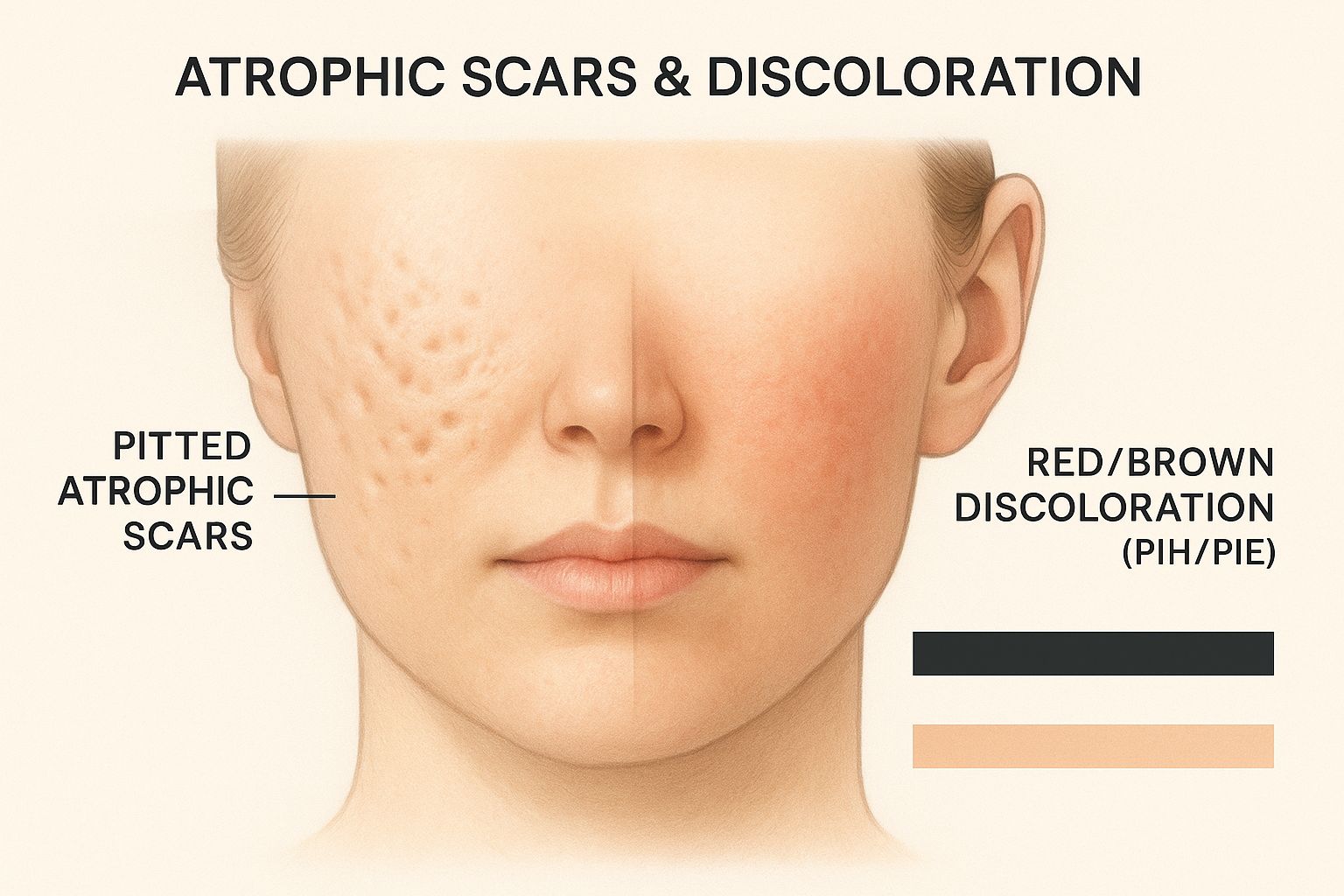
As you can see, textural changes are a structural issue deep within the skin. Discoloration is more of a surface-level problem—and thankfully, it's often much easier to resolve.
The Different Types of Atrophic Scars
Even within the "true scar" category, there are a few distinct types. Pinpointing which kind you have helps a professional map out the best treatment plan, since some procedures work better for specific scar shapes and depths.
Here are the three big ones:
- Ice Pick Scars: These are deep, narrow, V-shaped pits. They honestly look like the skin was punctured by something sharp, and their depth makes them the most challenging to treat.
- Boxcar Scars: Think of a chickenpox scar—that's a boxcar scar. They're broader depressions with sharp, defined edges and can be either shallow or deep.
- Rolling Scars: These give the skin an uneven, wavy appearance. They have sloping, undefined edges that create a rolling, undulating texture on the surface.
The key takeaway here is that for any indented scar, the goal is always collagen remodeling. You need treatments that push your skin to rebuild its own support structure from the inside out. For a visible difference in skin texture, exploring professional scarring treatments is almost always the most effective route.
To make this easier, here's a quick cheat sheet to help you identify what you might be seeing in the mirror.
Quick Guide to Acne Scar Types and Treatments
This table breaks down the common scar types, what they look like, and which treatments are typically the most effective.
| Scar Type | Visual Characteristics | Best Treatment Approach |
|---|---|---|
| Ice Pick | Deep, narrow, V-shaped pits | TCA CROSS, punch excision, targeted laser resurfacing |
| Boxcar | Broad depressions with sharp, defined edges | Microneedling, fractional lasers, dermal fillers, subcision |
| Rolling | Wide, shallow indentations with sloping edges | Subcision, microneedling, fillers, radiofrequency treatments |
| PIH (Brown Spots) | Flat, brown or dark spots on the skin | Topical retinoids, vitamin C, azelaic acid, chemical peels |
| PIE (Red Spots) | Flat, red or purplish spots | Niacinamide, azelaic acid, vascular lasers (like Vbeam) |
Remember, this is just a starting point. The best results often come from a combination of therapies tailored to your specific skin needs.
Decoding Post-Inflammatory Discoloration
Now, what if your marks are completely flat with no indentation at all? You’re likely dealing with discoloration, a much more common and treatable souvenir from past breakouts. The color of the spot is a major clue.
- Post-Inflammatory Hyperpigmentation (PIH): These are the brown, tan, or even black spots left behind. They’re caused by an overproduction of melanin (your skin's pigment) in response to inflammation. PIH is especially common in those with darker skin tones.
- Post-Inflammatory Erythema (PIE): These are the red, pink, or purplish spots. They’re the result of tiny, damaged blood vessels (capillaries) near the skin’s surface that were affected by an angry breakout. You’ll see PIE most often in lighter skin tones.
Knowing if you have PIH or PIE is absolutely critical. Why? Because the ingredients that fade brown spots (PIH) are totally different from the ones that calm down redness (PIE). Using a melanin-inhibitor on a red spot simply won't work.
Building Your At-Home Scar Fading Routine
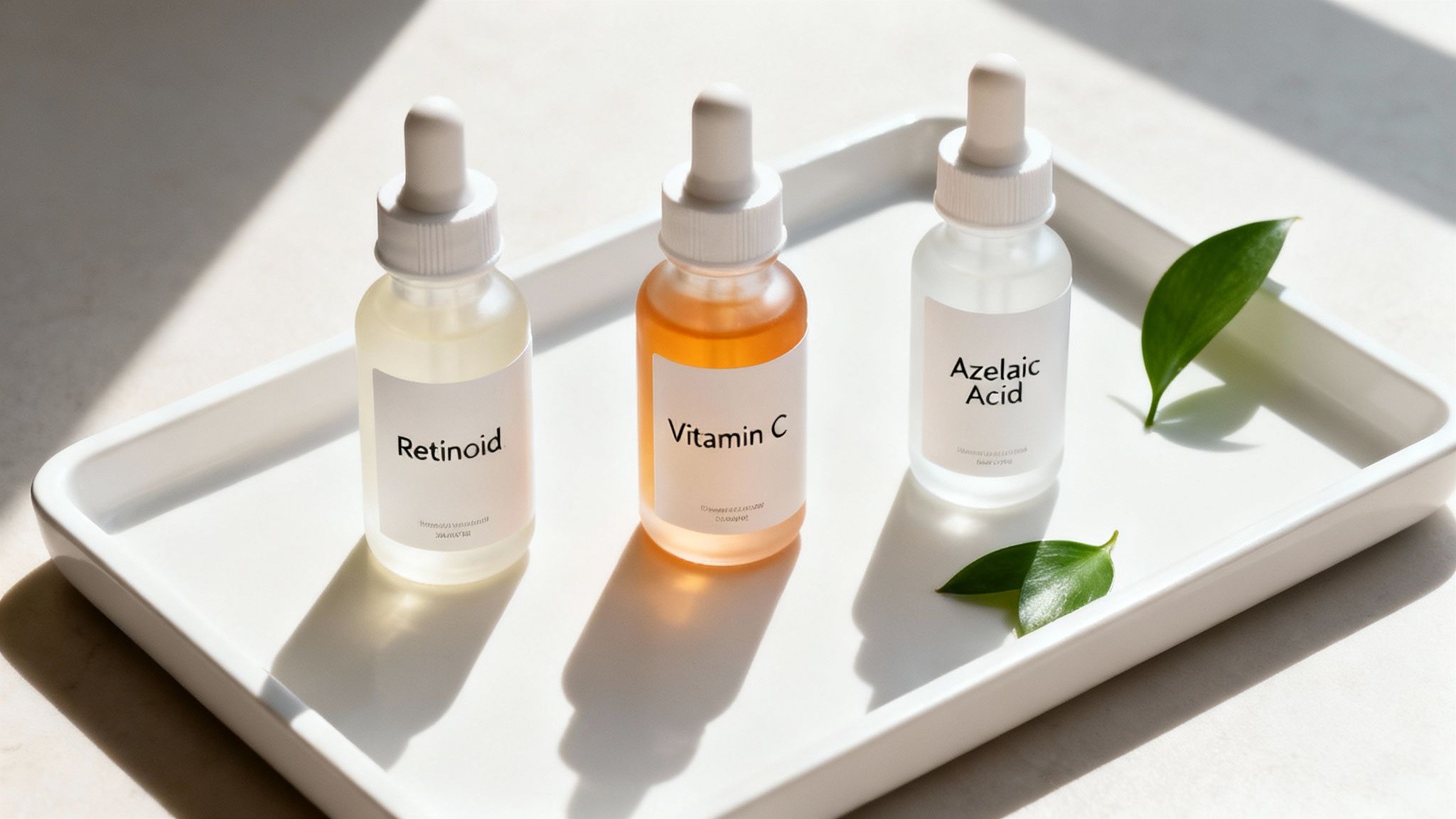
While significant changes in skin texture often need a professional's touch, your bathroom counter is the frontline for tackling the stubborn discoloration left behind by breakouts. Honestly, a consistent, targeted at-home routine is your most powerful weapon against those frustrating red and brown marks. It all comes down to choosing the right active ingredients and using them smartly to see real progress.
Think of it less as a quick fix and more as a long-term commitment. The right products work by speeding up cell turnover and hitting the brakes on excess pigment production. Over time, this gradually reveals clearer, more even-toned skin. The real trick is knowing which ingredients to look for and how to make them play nicely together in a routine.
The Powerhouse Ingredients for Fading Scars
When you're scanning product labels, a few key players consistently deliver results for post-inflammatory hyperpigmentation (PIH) and post-inflammatory erythema (PIE). These aren't just trendy; they're backed by solid science and are the ingredients skincare professionals like myself recommend day in and day out.
Here are the top ingredients to add to your scar-fading arsenal:
- Retinoids (Like Retinol or Adapalene): These are the gold standard for a reason. Retinoids essentially hit the fast-forward button on your skin's natural exfoliation process, pushing discolored cells to the surface and making way for fresh, new ones. Adapalene, which you can now get over-the-counter, is a fantastic choice for acne-prone skin.
- Azelaic Acid: This is a true multi-tasking hero for post-acne marks. It gently exfoliates, calms inflammation (which is great for red PIE marks), and—most importantly—it specifically targets the enzyme that creates excess melanin. This makes it a beast at fading brown spots (PIH).
- Vitamin C: A powerful antioxidant, Vitamin C is crucial for protecting your skin from daily environmental damage that can make discoloration worse. It also directly interferes with pigment production, helping to brighten your overall complexion and fade dark spots. To really understand its benefits, you can learn more about why you need Vitamin C in your routine.
Getting these actives into your lineup is the foundation of any effective plan for tackling acne scars at home.
Crafting Your Daily and Nightly Routine
Knowing the ingredients is one thing; knowing how to use them is the real game-changer. A classic mistake I see is people throwing everything at their skin at once. This usually just leads to irritation and a damaged skin barrier, which will only set you back. The goal here is to be strategic and consistent.
Here’s a sample framework for layering these products effectively. Just remember to start slow—introduce one new active at a time, maybe just a few nights a week, before building up to more frequent use.
Your Morning Routine (Focus on Protection)
- Gentle Cleanser: Start with a clean canvas, but don't strip your skin.
- Vitamin C Serum: Apply a few drops to dry skin. Think of it as an antioxidant shield against daily aggressors that darken marks.
- Moisturizer: Healthy skin needs hydration. A good moisturizer supports your skin barrier, which is essential for healing.
- Sunscreen (SPF 30+): This is non-negotiable. Seriously. Sun exposure makes red and brown spots darker and much more stubborn. It is the single most important step in your routine.
Your Evening Routine (Focus on Repair)
- Gentle Cleanser: Wash off the day's grime, makeup, and sunscreen.
- Active Treatment: This is where you'll rotate your powerhouse ingredients. For example:
- Night A: Retinoid (Adapalene or Retinol)
- Night B: Azelaic Acid
- Night C: Rest & Hydration (just use your cleanser and moisturizer)
- Moisturizer: Let your active sink in for a minute, then follow up with a moisturizer to lock in hydration and buffer any potential irritation.
Key Insight: The "skin cycling" approach—alternating active nights with recovery nights—is a brilliant strategy. It lets you get the powerful benefits of ingredients like retinoids without overwhelming your skin, dramatically reducing the risk of dryness and irritation.
This structured approach ensures your skin gets the full benefit of each ingredient without being sent into overdrive. Trust me, consistency is far more important than intensity. Fading acne scars is a marathon, not a sprint, and a steady, patient routine will always win the race, delivering visible results within a few months.
When Professional Acne Scar Treatments Are Worth It
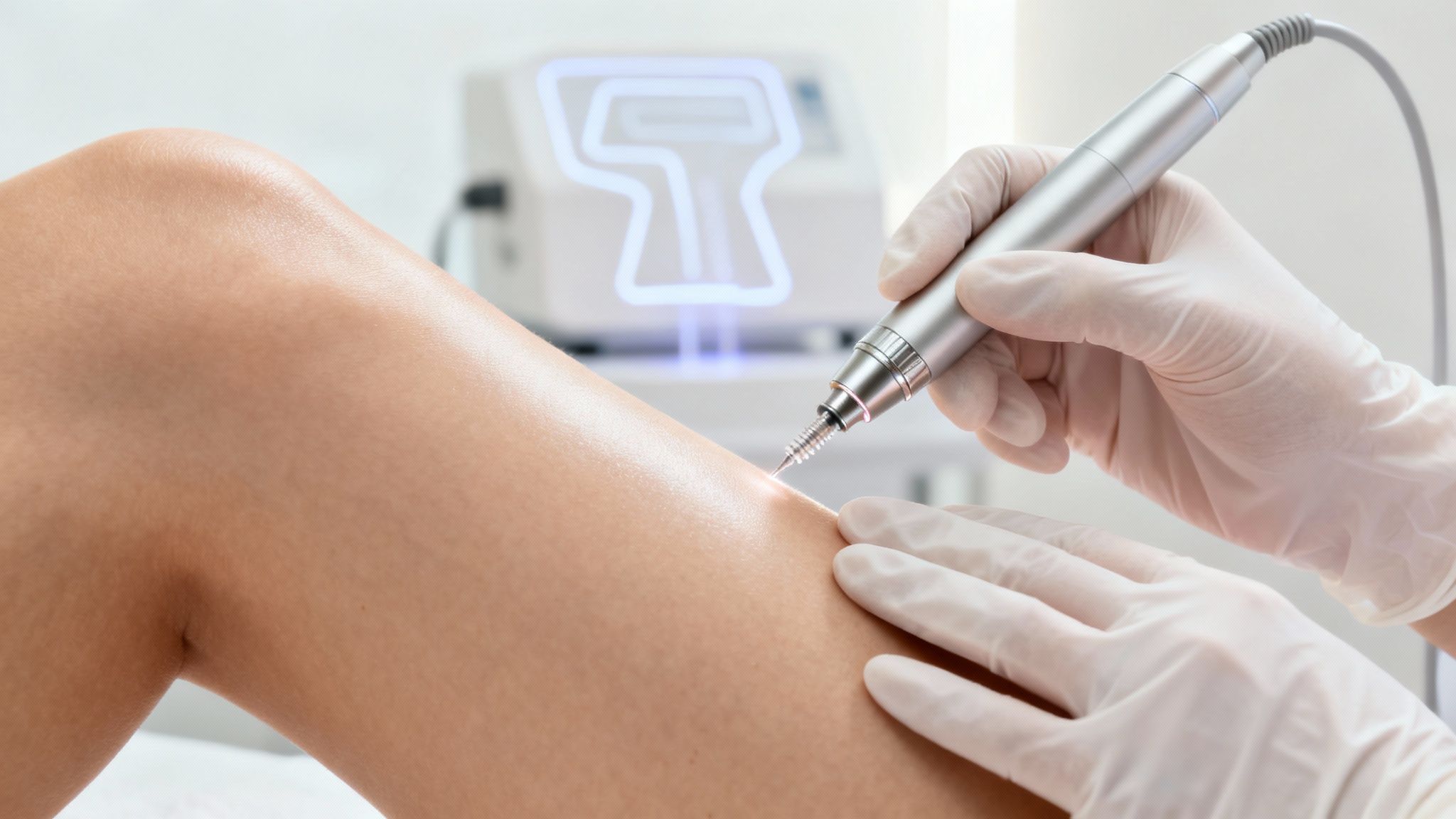
A solid at-home routine is your first line of defense against the dark spots and discoloration acne leaves behind. But let's be real—there comes a point where even the most powerful serums and creams just can't cut it anymore.
If you're dealing with actual textural changes, like pits and indentations in your skin, topical products simply can't deliver the kind of results you're hoping for. They work on the surface, fading pigment and encouraging cell turnover. What they can't do is rebuild the collagen and elastin that were destroyed when the scar formed in the first place.
So, if you've been diligently applying your products for six months or more and those indented scars are still staring back at you in the mirror, it’s a clear sign you’ve hit the limit of what topicals can achieve.
Making the Leap to In-Clinic Solutions
This realization is a huge turning point. It’s when managing acne scars shifts from a solo bathroom-counter effort to a collaborative partnership with a professional. And you’re definitely not alone in this—the demand for more powerful solutions is a massive global trend.
Acne affects over 9.4% of people worldwide, which has fueled a major shift toward professional treatments like laser therapy and microneedling. It signals a wider understanding that to fix deep, textural scars, you need a more direct and potent approach that can kickstart genuine skin remodeling from within.
What Really Happens in a Dermatologist's Office
Walking into a clinic can feel overwhelming, but knowing the main treatment categories ahead of time can empower you to have a confident, productive conversation. Most of these procedures work on a similar principle: they create a controlled "injury" to the skin. This intentionally triggers your body’s natural healing cascade, telling it to get busy building new, healthy collagen.
Here's a quick rundown of some of the most common and effective options out there:
Microneedling: A device with tiny, sterile needles creates thousands of micro-channels in your skin. This process is brilliant for breaking down old, stubborn scar tissue and sparking a surge of new collagen and elastin, which gradually fills in those indentations from the inside out. It's my go-to recommendation for many types of rolling and boxcar scars.
Chemical Peels: Don't let the name intimidate you. These aren't your average at-home peels. A dermatologist uses acids like trichloroacetic acid (TCA) at much higher, controlled concentrations to remove damaged outer layers of skin. This reveals the smoother, more even-toned skin underneath. A specialized technique called TCA CROSS is particularly amazing for stubborn, deep ice pick scars.
Laser Therapy: This is a big category, but it's mostly split into two types. Non-ablative lasers heat the underlying tissue to stimulate collagen without damaging the surface, meaning less downtime for you. Ablative lasers, like the well-known CO2 or Fraxel, are more intense—they precisely remove thin layers of skin. The results for severe scarring can be incredible, but they come with a longer recovery period.
Key Takeaway: The whole point of professional treatments isn't just to smooth the surface. It's to fundamentally rebuild your skin's support structure. This is precisely why these methods can do what creams and serums can't—they get to the root cause of indented scars.
Setting Realistic Expectations for Results and Recovery
It’s so important to go into this with the right mindset. Professional treatments are a journey, not a one-and-done magic wand. Most procedures require a series of sessions, usually spaced four to six weeks apart, to really get the best outcome.
Patience is everything. Because these treatments rely on your body's own collagen-building cycle, the final, most impressive results often don't become fully visible until three to six months after your last session. You'll definitely see gradual improvements along the way, but the big transformation takes time as your skin slowly rebuilds itself.
Here’s a realistic look at what you can expect for downtime:
| Treatment | Typical Downtime | Best For |
|---|---|---|
| Microneedling | 1-3 days of redness and minor swelling | Rolling scars, shallow boxcar scars, overall texture |
| Medium-Depth Peel | 5-7 days of peeling and redness | Discoloration, shallow textural irregularities |
| Non-Ablative Laser | 1-3 days of mild redness, like a sunburn | Mild to moderate scarring, minimal downtime needs |
| Ablative Laser | 7-14 days of significant redness, swelling, and peeling | Severe, deep scarring (boxcar, ice pick) |
For those looking into professional options, advanced treatments like Jet Peel Facial treatments can offer a gentler alternative or a great complementary procedure for improving skin texture. And if you're curious about laser, this comprehensive guide to Fraxel laser treatment for acne scars is a fantastic resource that dives deep into one of the most popular options available.
Ultimately, investing in professional treatments is absolutely worth it when your at-home routine just isn't enough anymore. When you walk into a consultation armed with knowledge, you can work with your provider to create a plan that will finally help you achieve the smoother skin you’ve been working so hard for.
The Global Quest for Clear Skin
If you're looking for ways to get rid of acne scars, you’re definitely not alone. The desire for smoother, clearer skin is a universal one, and it's fueling a massive wave of innovation across the dermatology and aesthetics industries. This collective drive is precisely why we're seeing so many breakthroughs in both professional treatments and at-home skincare.
This shared goal has ignited incredible growth. The global market for acne scar treatments is on a remarkable trajectory, expected to jump from around USD 8.0 billion in 2023 to a massive USD 15.9 billion by 2033. That’s a compound annual growth rate of 7.1%, which tells you just how many people are investing in their skin. For a closer look at the trends driving this, you can explore the global acne scar treatment market analysis here.
Why the Sudden Obsession with "Flawless" Skin?
So, what’s behind this surge? A lot of it comes down to a major cultural shift. We live in an incredibly visual world, thanks to social media, high-definition cameras, and the whole "selfie culture" phenomenon. Our faces are front and center like never before.
This constant stream of images makes us acutely aware of our skin's texture, tone, and imperfections. A minor scar that might have gone unnoticed a decade ago can now feel like it's under a spotlight. This has pushed people to find solutions that deliver real, visible improvements. It's less about vanity and more about feeling confident in a world that’s always "camera-ready."
Who's Spending, and Where?
Beyond our cultural landscape, simple economics are a big part of the story. As disposable incomes rise around the world, more people can finally afford advanced aesthetic treatments that were once seen as a luxury. This boost in spending power is a direct line to market growth.
When you look at the map, some interesting patterns emerge:
- North America's Big Share: Right now, North America is the market leader, making up about 32% of the global total. This is largely due to high consumer awareness, a culture of spending on personal care, and easy access to top-tier clinics and technology.
- A Worldwide Movement: While North America is out front, other regions are catching up fast. This isn't just a Western trend; it's a global one. From Asia to Europe, clinics are offering increasingly sophisticated treatments to meet local demand.
The bottom line is this: Your personal journey to clearer skin is part of a much bigger story. The entire industry is responding to what people like you want, which means more research, better technology, and more accessible treatments are hitting the market every single year.
How Your Demand Fuels Better Technology
All of this market demand has a direct and powerful effect: it funds the next generation of dermatological science. The money pouring into this sector supports the research and development that leads to safer, more effective treatments with less downtime.
Think about the evolution of laser technology. We’ve moved from aggressive, old-school lasers that required weeks of recovery to refined fractional lasers that give amazing results with just a few days of redness. That shift happened because consumers demanded powerful outcomes without having to hide away for a month. We're seeing the same thing with advancements in microneedling and radiofrequency, which are making collagen stimulation more precise and predictable than ever.
Knowing this global context can be really empowering. It validates your own desire for better skin and shows that you're part of a movement that is actively shaping the future of skincare. The solutions you're searching for are getting better all the time, precisely because so many others are searching for them too.
Don’t Just Treat Scars—Prevent Them from Ever Forming
While tackling existing acne scars is a big win, the best long-term strategy is to stop them from showing up in the first place. This means shifting your mindset from damage control to prevention. By building a smart daily routine, you support your skin's natural healing process and drastically reduce the chances of a breakout leaving its mark.
Think of it as playing the long game. Every good habit you build today is an investment in clearer skin tomorrow, helping you avoid stubborn textural changes and discoloration down the line. It all boils down to a consistent, gentle, and intelligent approach to your daily skincare.
The Foundations of a Scar-Proof Skincare Routine
Preventing acne scars doesn't mean you need a bathroom counter cluttered with a dozen products. It's about getting the fundamentals right, day in and day out. The goal is simple: keep your skin calm, clean, and protected so it can heal efficiently when a breakout does occur.
Here are the absolute non-negotiables:
- Cleanse Gently: Harsh, stripping cleansers are your enemy. They can trigger more inflammation and weaken your skin's protective barrier, making you more likely to scar. Always reach for a gentle cleanser that's labeled "non-comedogenic"—that's the key phrase meaning it won't clog your pores.
- Use a Targeted Treatment: Don't slather harsh products all over your face. Apply a spot treatment with an ingredient like salicylic acid or benzoyl peroxide directly onto active pimples. This directly targets the inflammation, which is the root cause of both scarring and post-acne marks.
- Moisturize Daily: Yes, even oily and acne-prone skin desperately needs hydration. A lightweight, oil-free moisturizer is essential for maintaining a healthy skin barrier. Think of that barrier as your skin's first line of defense; a strong one is crucial for healing properly.
This focus on consistent at-home care isn't just a hunch; it's a global trend. In China, for instance, the acne scar treatment market is growing at a staggering 12.9% annually. And what makes up the lion's share of that market? Topical treatments like exfoliating acids and retinoids, holding a 42% market share. It’s a clear sign that people are leaning into building powerful, preventative routines at home. You can learn more about the rise of topical acne scar treatments on Future Market Insights.
Sunscreen: Your Most Powerful Preventative Tool
If you only take one piece of advice from this entire guide, make it this: wear sunscreen every single day. I can't stress this enough. Sun exposure is public enemy number one for those dark spots (post-inflammatory hyperpigmentation, or PIH) that linger long after a pimple has healed.
UV rays kick your skin's melanin production into overdrive. For a healing spot, this means that mark will get significantly darker and stick around for months, or even years, longer than it should have. A broad-spectrum sunscreen with at least SPF 30 is non-negotiable.
My Pro Tip: Sunscreen is the final step in your morning routine. No exceptions. It doesn't matter if it's cloudy, if you're just driving, or if you're working from home. UV rays slice right through windows, and it’s that consistent, daily protection that makes all the difference.
Whatever You Do, Don't Pick
I know. The urge to pick, pop, or squeeze a pimple can feel overwhelming. But doing so is the fastest way to turn a temporary blemish into a permanent scar. Squeezing a pimple creates a much bigger, more traumatic wound than the original spot.
Here’s exactly what you’re doing when you pick:
- You’re forcing bacteria and pus deeper into the skin, which just fuels more inflammation.
- You’re physically tearing your skin, which can easily lead to a pitted, indented scar.
- You’re introducing new bacteria from your fingers, which can cause a full-blown infection.
A great way to break this habit is to use hydrocolloid pimple patches. They create a physical shield over the spot, making it impossible to pick. As a bonus, they also gently draw out fluid, helping the blemish heal faster and flatter.
Calm Your Skin from the Inside Out
Your skin doesn't exist in a vacuum; it’s a direct reflection of your overall health. High levels of inflammation throughout your body can worsen acne and dramatically increase the odds of scarring. While your skincare routine is your primary weapon, a few lifestyle tweaks can provide powerful backup.
Try adding more anti-inflammatory foods to your diet—think leafy greens, berries, and fatty fish like salmon. For some people, cutting back on processed sugar and dairy can also make a huge difference in calming their skin. When you support your body's overall health, you create the perfect environment for your skin to heal cleanly, leaving far fewer reminders behind.
Your Top Acne Scar Questions, Answered
When you're dealing with acne scars, it feels like there's a mountain of information out there—and not all of it is helpful. It's easy to get overwhelmed. I get it. So, let's cut through the noise and tackle the questions I hear most often from clients who are ready to finally get their skin on the right track.
You know how to spot your scar type and you've seen the treatment options. Now, let's get into the practical side of things.
Can Acne Scars Actually Be Removed Completely?
This is usually the very first thing people ask, and the honest-to-goodness answer is… it's a tale of two different skin concerns. It really boils down to whether we're talking about discoloration or actual texture changes.
If you're dealing with those stubborn red or brown marks left behind after a pimple (post-inflammatory hyperpigmentation or erythema), the news is great. With a solid at-home routine using things like retinoids and azelaic acid—and being absolutely religious about sunscreen—getting those marks to fade completely is a realistic goal. These are pigment issues, not permanent texture changes, so they can be resolved.
But when we're talking about true atrophic scars—the indented ice pick, boxcar, and rolling types—our goal shifts from erasure to improvement. Since these scars represent a physical loss of collagen, making them vanish entirely isn't on the table. Instead, professional treatments focus on making them dramatically better, often reducing their depth by 50-70% or more. The end result is skin that looks so much smoother that the scars are barely noticeable.
My Takeaway: Think of it as remodeling the skin, not demolishing the old structure. We're prompting your body to build new, healthy collagen to fill in those indentations and even out the landscape. Getting your expectations aligned with this reality is the single most important step for a successful treatment journey.
How Long Does It Really Take to See Results?
I know you want to see changes yesterday, but skin plays by its own rules. Patience is probably the most crucial—and most difficult—part of any scar treatment plan. Rushing things almost always leads to irritated skin and a lot of frustration.
Here’s a realistic timeline based on what I see every day:
At-Home Topicals (for Discoloration): When you're using products to fade red or brown spots, you might see the first hints of progress in 4 to 8 weeks. But for those really noticeable, satisfying results on stubborn marks? You’re looking at 3 to 6 months of consistent, daily use. No skipping!
In-Clinic Procedures (for Texture): This is a longer game because we're physically rebuilding the skin's foundation. After you finish a series of microneedling or laser sessions, the most impressive results often won't fully reveal themselves for another 3 to 6 months. That's because the collagen and elastin remodeling process is a slow burn that continues long after you've left the clinic.
That waiting period isn't just downtime; it's when the real magic is happening under the surface.
Are At-Home Microneedling Tools Safe for Scars?
I'm going to be blunt here: this is a hard "no" from me and virtually every other skin professional out there. The idea of a DIY shortcut is tempting, but the risks of using at-home dermarollers or pens on acne scars are just too high. You can very easily make your skin worse.
Here's exactly why this is such a bad idea:
- Huge Infection Risk: You simply cannot sterilize these tools to a medical-grade standard in your bathroom. This opens the door for nasty bacteria to get deep into your skin, potentially causing a serious infection and, ironically, even more scarring.
- Damaging Technique: Professional microneedling creates clean, vertical micro-channels. Those at-home rollers often have duller needles that drag and tear at the skin. Instead of stimulating collagen, you’re creating micro-tears that wreck your skin barrier and can make texture worse.
- The Wrong Depth: An expert knows exactly what needle depth to use for different scar types and different areas of the face. Go too shallow at home, and you’re doing nothing. Go too deep, and you're causing real damage.
Professional microneedling is a controlled medical procedure for a reason. It uses sterile, single-use needle cartridges and a trained hand. For the sake of your skin's health, this is one area where you should never, ever DIY.
What's the Single Best Treatment for Deep, Indented Scars?
There isn't one. The truth is, the most dramatic and life-changing results for deep scars almost always come from a smart combination of therapies.
Think of a skilled dermatologist or esthetician as a strategist. They'll assess your unique mix of scars, your skin tone, and how you heal to build a multi-step plan of attack. For someone with deep boxcar or rolling scars, a powerful, highly effective approach often looks like this:
- First, Subcision: A special needle is used to go under the skin and physically break up the tough, fibrous bands that are pulling the scar down. This literally "releases" the indentation, allowing it to pop back up.
- Next, Dermal Fillers: Right after subcision, a bit of hyaluronic acid filler can be injected into the space. This provides an immediate lift and acts as a spacer, preventing the scar from tacking back down as it heals.
- Then, Collagen Stimulation: Over the next several months, a series of treatments like radiofrequency microneedling or a fractional laser is used to kickstart your body's own collagen-building factory, smoothing and strengthening the skin from the inside out.
This is how you get incredible results—by tackling the scar from below, from within, and from the surface. It’s why a professional consultation is so critical. It’s not about finding one magic bullet; it’s about creating your personal battle plan.
At Face of Jules, we know that no two scars are the same. We believe in creating a truly personalized plan to help you achieve clear, healthy skin you feel great in. If you're ready to get started, our experts are here to guide you. Explore our advanced treatments and book your consultation today.